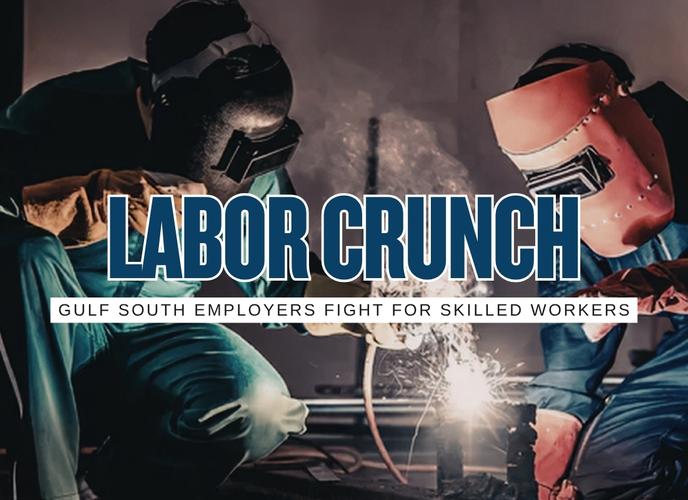
The labor squeeze is no longer limited to one trade or one parish. The same welder may be recruited by a shipyard, a module fabricator, an LNG contractor, a refinery maintenance provider, a data center builder, or a construction subcontractor. That competition is changing wages, timelines, bids, training, and retention across the Gulf South.
Labor Market Snapshot
The Gulf South has always depended on skilled hands. Ports, refineries, LNG terminals, shipyards, bridge contractors, offshore service companies, utilities, industrial plants, marine fabricators, trucking firms, and local builders all rely on people who can safely install, repair, weld, wire, fit, operate, inspect, and supervise complex work.
The difference now is the number of sectors pulling from the same labor pool at the same time. Louisiana alone has seen a large wave of announced investment, including industrial, energy, port, manufacturing, and technology projects. Those projects do not only need engineers and executives. They need craft workers, foremen, drivers, safety coordinators, estimators, mechanics, electricians, riggers, pipefitters, and people who can show up ready for field conditions.
The Pressure Stack
The Gulf South labor crunch is not one single shortage. It is a stack of overlapping pressures that land on employers at the same time. A local contractor may be trying to fill a foreman position while losing a welder to industrial work, waiting on an electrician, paying more for travel labor, and watching a bid schedule tighten because a larger project pulled crews out of the local market.
| Pressure Point | Business Impact | Employer Response |
|---|---|---|
| Industrial Projects | Large LNG, petrochemical, steel, energy, and data center projects can raise the wage floor for electricians, pipefitters, operators, welders, and supervisors. | Create earlier hiring calendars, use retention bonuses carefully, and build relationships with trade schools before urgent hiring starts. |
| Marine Work | Shipbuilding, repair, offshore service, tug operations, and port work require specialized skills that are not always interchangeable with standard construction labor. | Train for marine-specific safety, confined spaces, welding standards, vessel systems, and port access requirements. |
| Travel Labor | Per diem jobs can pull experienced workers away from local employers, especially during turnaround and project surges. | Offer predictable scheduling, clear advancement, better crew leadership, and local-life advantages that travel jobs cannot provide. |
| Aging Workforce | Experienced tradespeople carry field judgment that is difficult to replace quickly. When they retire or reduce hours, productivity drops. | Use mentor pay, structured shadowing, and supervisor transition plans before key workers leave. |
| Project Timing | When several large jobs peak at the same time, smaller employers may struggle to staff routine service calls, maintenance work, and local commercial projects. | Forecast labor needs by quarter, not only by open job order. Build standby pools and subcontractor backup lists. |
Roles Most Exposed to the Crunch
Not every role is equally difficult to fill. The most exposed positions usually combine three traits: technical skill, safety risk, and immediate field productivity. Employers can find entry-level applicants, but the shortage becomes sharper when the job requires certifications, site experience, clean safety habits, leadership judgment, or the ability to work in heat, weather, heights, confined spaces, industrial sites, ports, and marine environments.
- Electricians and electrical helpers: Demand is being pushed by commercial construction, industrial expansion, grid work, data centers, controls, charging infrastructure, and facility upgrades. Electrical contractors may face some of the toughest competition because nearly every growth sector needs them.
- Welders and fitters: Marine fabrication, industrial modules, ship repair, offshore support, pipe work, and structural steel all compete for people who can pass tests, read drawings, work safely, and maintain quality under schedule pressure.
- Pipefitters and millwrights: LNG, petrochemical, refinery, and heavy industrial projects depend on workers who understand layout, alignment, tolerances, mechanical systems, and jobsite sequencing.
- Equipment operators and CDL drivers: Road work, civil construction, port logistics, utility projects, storm cleanup, aggregate hauling, and industrial site prep all increase demand for reliable operators and drivers.
- Marine electricians, mechanics, and vessel technicians: These roles require a blend of practical troubleshooting, marine system knowledge, safety awareness, and comfort working around vessels, docks, yards, and tight access points.
- Foremen and field supervisors: The tightest shortage is often leadership. A skilled worker can finish tasks. A strong foreman protects schedule, safety, morale, quality, equipment, materials, and client confidence.
Marine Jobs Add a Different Layer
The marine side of the Gulf South labor market deserves its own attention because the work is specialized, physical, and often misunderstood by workers outside the industry. A person who can weld in a standard shop may still need additional training to thrive in a shipyard, on vessel repair work, around offshore equipment, or inside a port environment.
Marine employers also face recruiting friction because the industry is less visible to students and career changers than residential construction, commercial construction, trucking, or oilfield work. Many people live close to the water, drive past ports, or know someone in the industry, but still do not understand the range of jobs available: deckhands, marine mechanics, shipfitters, electricians, coatings workers, crane operators, port labor, dispatchers, compliance staff, vessel operations coordinators, and safety roles.
Marine Employer Advantage
A Gulf Coast marine company can stand out by making the career path visual. Show entry-level workers the ladder from helper to technician, from deckhand to captain, from yard labor to certified welder, or from apprentice electrician to marine systems specialist. The more specific the path, the easier it is to recruit people who have never pictured themselves in maritime work.
Marine companies should also be honest about conditions. Heat, long shifts, weather, safety rules, travel, and physical work are part of the job. But the upside is real: specialized skills, port access, vessel knowledge, overtime potential, certifications, and a career that is harder to outsource than many office roles.
Construction Firms Face Margin Pressure
For Gulf South construction companies, labor scarcity does not only affect hiring. It changes project economics. A contractor may bid a job using one labor assumption, then watch available crews tighten before mobilization. Subs may carry more risk into bids. General contractors may build more schedule float into timelines. Owners may see higher pricing, longer lead times, and more negotiation around change orders.
The labor crunch can also increase the cost of mistakes. A bad hire is expensive when a company has extra applicants. A bad hire is much more expensive when the schedule is tight, the crew is already stretched, and replacement candidates are limited. This is especially true for safety-sensitive jobs where one weak link can create delays, injuries, rework, or client frustration.
| Contractor Risk | Early Warning Signal | Practical Fix |
|---|---|---|
| Underpriced labor | Bid numbers assume full crew availability at old wage rates. | Refresh labor assumptions before final bid submission and include market-sensitive contingencies. |
| Supervisor overload | Foremen are covering too many crews, jobs, or client calls. | Create assistant foreman roles and pay experienced workers to mentor replacements. |
| Training gaps | New hires are present but not productive fast enough. | Use a 30-day skill checklist with task signoffs instead of informal shadowing only. |
| Retention leakage | Workers leave for a small raise or per diem job with little notice. | Use stay interviews, predictable overtime, better communication, and career-step raises. |
| Safety drift | Rushed crews start skipping basics because experienced workers are thin. | Protect safety meetings, refresh job hazard analysis habits, and avoid rewarding speed over discipline. |
Smaller Employers Need a Different Playbook
Small and mid-sized Gulf South businesses cannot always match mega-project pay, national contractor recruiting budgets, or per diem packages. That does not mean they are helpless. Local employers can compete by offering speed, trust, stability, respect, and a clearer future.
A worker may choose a smaller employer if the company offers a better daily experience: a fair supervisor, reliable hours, less travel, faster promotion, skills training, flexible family time, steady local work, and a workplace that does not treat employees as replaceable. In a tight labor market, culture becomes a recruiting tool. It also becomes a retention tool.
- Speed up hiring: Good trade candidates may not wait two weeks for a callback. Respond fast, schedule interviews quickly, and make the next step clear.
- Advertise the actual life of the job: Include schedule, travel expectations, overtime reality, site type, pay range, training path, and advancement potential.
- Build entry-level ramps: Create helper positions with written skill ladders instead of expecting every applicant to arrive fully trained.
- Protect your best supervisors: People often leave managers before they leave companies. Foreman training can be a retention investment.
- Use local identity: Many workers want to stay near family, schools, fishing, hunting, churches, ball fields, and community. Local stability can beat higher short-term travel pay for the right candidate.
Local Employer Strategies That Can Work
The strongest employer strategy is not one tactic. It is a system. The Gulf South companies that perform best in a tight labor market usually combine recruitment, training, retention, scheduling, and leadership into one operating plan.
| Strategy | Best Use | Execution Detail |
|---|---|---|
| Apprenticeship partnerships | Electrical, welding, plumbing, HVAC, marine, mechanical, and industrial roles | Partner with community colleges, technical schools, workforce boards, high schools, veterans groups, and apprenticeship providers. |
| Skill ladders | Entry-level helpers and career changers | Publish clear steps from helper to lead worker, including skills, pay bands, certifications, and expected timeframes. |
| Stay interviews | Retention of top workers | Ask strong employees about schedule, tools, supervision, pay fairness, training, and frustrations before they resign. |
| Referral bonuses | Hard-to-find craft workers | Pay part at hire and part after the new worker completes a retention period, such as 90 or 180 days. |
| Supervisor development | Foremen and crew leads | Train supervisors in communication, conflict handling, documentation, safety coaching, and production planning. |
| Flexible crew design | Seasonal or project-based demand | Build a core crew, a trained part-time bench, and trusted subcontractor relationships before the rush begins. |
The New Competition From Data Centers and Energy Infrastructure
One of the newer labor pressures in the Gulf South is the rise of data center and power infrastructure work. These projects compete for electricians, HVAC technicians, fiber workers, mechanical trades, concrete crews, equipment operators, and supervisors. They may not create as many permanent jobs as they do construction jobs, but during the buildout phase they can pull from the same labor pool as industrial construction, utilities, commercial building, and maintenance contractors.
This matters for local employers because a business that once competed mostly with nearby contractors may now compete with national infrastructure spending. Electrical and mechanical talent becomes especially sensitive to wage changes, certification demand, overtime, and travel packages.
Planning Move for 2026
Employers should map upcoming projects within a practical recruiting radius. If a major site is expected to mobilize nearby, start retention conversations early. Waiting until workers receive outside offers is usually too late.
Workforce Housing and Commute Stress
Labor supply is not only about pay. It is also about housing, commute time, transportation, childcare, and daily quality of life. Gulf Coast industrial and construction activity can create temporary housing pressure near project clusters. When workers cannot find affordable short-term housing or reasonable commutes, employers may need to raise per diem, adjust schedules, or accept higher turnover.
For small employers, this creates an opportunity to compete on stability. A local job that allows a worker to sleep at home, coach a youth team, attend church, pick up children, or avoid hotel living can be a strong recruiting message. The key is to say it clearly instead of assuming workers will connect the dots.
Training Must Get More Practical
The Gulf South does not need training for training’s sake. Employers need training that produces job-ready workers faster. That means shorter skill modules, employer-led task lists, tool familiarity, safety habits, certification support, and field exposure. A worker does not become fully experienced in a few weeks, but a structured ramp can reduce the time between hiring and productivity.
Effective training should answer three business questions. Can this person work safely? Can this person complete useful tasks without constant supervision? Can this person advance into a role the company will need six months from now?
| Training Level | Focus | Success Marker |
|---|---|---|
| First 7 days | Safety basics, attendance expectations, tools, site behavior, crew assignment | Worker understands expectations and avoids preventable early mistakes. |
| First 30 days | Task checklists, basic production skills, equipment handling, documentation habits | Worker can complete useful tasks with limited rework and steady supervision. |
| First 90 days | Certifications, trade-specific skills, quality checks, customer or site communication | Worker shows reliability, safe habits, and clear direction for advancement. |
| First year | Specialization, leadership potential, cross-training, retention planning | Worker becomes harder to replace and more valuable to the company. |
Labor Gap Cost Estimator
Use this simple planning tool to estimate the monthly cost of unfilled skilled positions. It is not an accounting model, but it helps employers visualize lost production, overtime strain, and delayed work.
Estimated exposure from unfilled roles
This estimate combines lost production value, extra overtime or subcontractor cost, and schedule risk pressure.
Planning note: Replace the default numbers with your own production value, overtime cost, and average vacancy length. For bidding, use conservative assumptions and update them before final pricing.
Owner and Manager Checklist
For Gulf South employers, the labor market is now a strategic issue. It belongs in the same conversation as pricing, insurance, equipment, marketing, project selection, customer service, and cash flow.
- Audit every open role: Separate must-have skills from trainable skills. Many job posts repel good candidates by asking for too much.
- Publish pay ranges when possible: Skilled workers often skip vague listings because they assume the employer is hiding weak compensation.
- Shorten the hiring process: A strong candidate may receive multiple calls in the same week. Slow employers lose.
- Track quits by supervisor: If one crew or department loses more people than others, the issue may not be the market alone.
- Create a 90-day ramp: New hires should know the skills, certifications, and habits needed to move forward.
- Build school and veteran pipelines: Career changers, veterans, technical students, and high school graduates can become strong long-term workers if the path is clear.
- Protect experienced workers: Your best people are recruiters, trainers, quality control, and culture carriers. Losing them costs more than their wage rate.
- Plan around project surges: Watch local LNG, port, highway, data center, industrial, and shipyard activity. Large projects can change the local hiring market quickly.
Bottom Line for Gulf South Businesses
The labor crunch is not only a hiring problem. It is a competitiveness test. Employers that treat workforce planning as a last-minute HR task will keep reacting to shortages. Employers that build training ladders, protect supervisors, recruit earlier, communicate better, and make skilled work more visible can turn a tight labor market into a long-term advantage.
The Gulf South has the projects, ports, energy assets, industrial base, marine knowledge, and local work ethic to benefit from the next wave of investment. The limiting factor may be the number of trained people ready to do the work. For business owners, that means the smartest labor strategy is not simply paying more. It is becoming the kind of employer skilled people want to stay with.